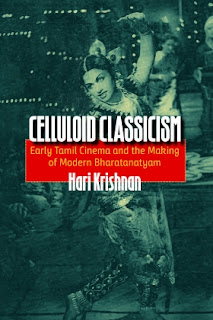
Back in August of last year, as I emerged from a period of gripping ennui that had largely led to my blog hiatus, I eagerly went on an internet search jaunt to see what new finds might be out there, and I happened onto Hari Krishnan's just-published book, Celluloid Classicism: Early Tamil Cinema and the Making of Modern Bharatanatyam. Within the blink of an eye I had ordered it, and I have slowly been reading it in earnest.
Reading through this masterful contribution has been riveting. Every chapter is filled with one exciting piece of information after the other, populated with the names of people and films I've encountered over my years of trying to quench my thirst for knowledge of a topic that is little-researched, reclusive, and under-appreciated.
But the book is not simply a descriptive work that reveals anecdotes and tales from the past. Having dug deep into archives, film print culture, personal collections, and a few candid interviews, Hari is out to explain the significance of the information, make connections, and contribute meaningful and new ideas to the world of scholarship on Indian dance and cinema and the real people and communities involved— the book is based on his doctoral dissertation, after all!
The central arguments of his book are something I've never heard anyone even hint before about Bharatanatyam. As the back cover describes, "This book unsettles received histories of modern Bharatanatyam by arguing that cinema [...] bears heavily and irrevocably upon iterations of this 'classical' dance" and that there was a "reciprocal exchange of knowledge between screen and stage versions of Bharatanatyam in the early decades of the twentieth century." That's quite tame frankly, given that by the time one has made it to the end of the book, the "exchange" and "heavy bearing" are clearly even more significant.
A few days ago, an article on Madame Menaka by the great Indian dance historian Sunil Kothari was published in The Asian Age, and I was heartenedto see that the title of his article is about his viewing a clip from "The Tiger of Hastinapur," which by his description of the brief tiger and king visuals and reference to my blog, is clearly the video clip I posted online years ago from the 1938 German feature film Der Tiger Von Eschnapur (see here and here) which, due to the editing program I used, included brief glimpses of the scenes before and after the dance sequence. I love knowing that rare video clips I have posted or sourced are being seen by such knowledgeable people as Kothari who lived through so much of India's dance history! There is some confusion and perhaps typos in Kothari's article, given that the photo and descriptions he references from Damayanti Joshi's book on Madame Menaka, which I own, actually refer to the film and the photo still as "Die Tiger von Eschnapur," not "The Tiger of Hastinapur," and he also amusingly refers to me as "Milai Milan." :)
Anyway, Kothari's article prompted me to see if any new Madame Menaka finds had surfaced online in recent years, and through a quick search I discovered something EXTRAORDINARY: some Indian dance and music history enthusiasts/scholars in Germany have created an online archive, "The Menaka Archive," dedicated entirely to Madame Menaka (aka Leila Roy-Sokhey, 1899-1947) and her Indian ballet group's European performance tour from 1936-1938 at http://menaka-archive.org! Note that the archive is in the German language, and while it does have an English option, the English translations seem to be automatically generated so are not fully accurate; I have linked to those pages or linked to/used automatic Google Translate translations throughout this post where possible (but for those that appear in German, you'll need to use the translation features of a browser like Google Chrome).
The archive looks to be the brainchild of two Germans, Markus Schlaffke, a documentary filmmaker and doctoral student at the Bauhaus University Weimar researching the Menaka Ballet in Europe, and Isabella Schwaderer, a research associate at the University of Erfurt who is also working on a project about the European reception of the 1936-1938 Menaka ballet tour. The efforts looks to have sprung from the artistic research project/collective of which Schlaffke and Schwaderer seem to be a part, Zinda Naach, that has aimed to hold Indian dance performances in recent years along the original route of the Menaka tour. In such coincidental timing related to Kothari's November 11 article this month, the Zinda Naach Facebook page (which writes in English) shared that The Menaka Archive went live a few days earlier on November 6, proclaiming:
... We are now able to trace Madame Menakas performances in Europe from an overall perspective for the first time. Over the last years we have researched documents of Menakas performances in Europe in hundreds of Archives and private collections. We have ordered these finds and assigned them to a digital database that is now available to the public as 'The Menaka Archive' (www.menaka-archive.org). We understand The Menaka Archive as a collaborative platform for further research and reconstruction of a specific history of artistic modernity, written jointly by dancers and musicians in India as well as in Germany ... The Zinda Naach performances will from now on continue as a series of events under the umbrella of The Menaka Archive in order to activate and decipher its archival findings. We kindly invite you to explore The Menaka Archive holdings and to contribute to its research program.
The first thing visitors to the Menaka Archive see is—guess what!—the other Menaka troupe dance from the 1938 film Der Tiger Von Eschnapur! I think the archive's version, given the sharper appearance and some scratch lines, may come from a copy of the film in Germany, rather than the lesser-quality but longer one I had found and posted. Here's a screencap of the archive's homepage:
How excited I am to recently find two more visual records of Guru Gopinath dancing in the mid-1940s, one in the commercial Tamil film Mahatma Udhangarand one archival find at the British Film Institute (BFI)! Back in the dance revival decades of pre and post-independence India, Guru Gopinath was among the trained native Kathakali dancers who brought that dance form and its movement vocabulary to other parts of India and the world. Gopinath did this first through a touring partnership with the American-born dancer known as "Ragini Devi," and later by creating a Kathakali-derived accessible dance form that seems to be known today as "Kerala Natanam." Gopinath has been featured on the blog twice before in dance footage from the 1950s. First was his portly and entertaining dance with Guru Gopalakrishnan/the mohini in the mythological "Mohini Bhasmasur" sequence in the 1957 Telugu/Tamil film Mayabazar, and second was the rare archival find of brief clips from his stage performance in the U.S.S.R. in 1954 as part of the Indian Cultural Delegation. But these new finds are special because they are from a decade earlier, and feature Gopinath looking noticeably younger and thinner!
Gopinath's Dance in Mahatma Udhangar (1947, Tamil)
Mahatma Udhangar (also transliterated Mahathma, Udangar, Udankar) was an unsuccessful release directed by G. Pattu Iyer that "sank without a trace and is barely remembered today" [6], which must explain why there's so little information readily available on the film. I shared more information about Mahatma Udhangar in my last post rejoicing about finding Kumari Kamala's dance in the film.
I'm back to immersing myself in searching and research, and what do I find this month but two film dances of Kamala that I've never seen before in the 1947 Tamil film Mahatma Udhangar and the 1958 Tamil film Illarame Nallaram! Then I also discovered that the Films Division Bharata Natyam documentary she was in is now viewable in a higher resolution, and her Bharatanatyam dance in the 1956 Hindi film Chori Chori has been colorised! Let's take a look at all these finds, one by one.
The path to discovering the two new film dances started with a new-to-me photo of Kamala that popped up in a Google Images search, which led me to her updated Wikipedia entry that I noticed now has a longer "Partial Filmography" section, which reminded me of the film dances of hers I'm still looking for, which then led to some searching that revealed these new finds! There's also a great dance of Guru Gopinath in Mahatma Udhangar, but I'll save that for a separate upcoming post.
Mahatma Udhangar (1947, Tamil)
According to the ever reliable font of Indian film history and dance Randor Guy, Mahatma Udhangar (also transliterated Mahathma, Udangar, Udankar) was an unsuccessful release directed by G. Pattu Iyer that "sank without a trace and is barely remembered today" ("Remembering D.K. Pattammal," Galatta Cinema, September 2009), which must explain why there's so little information readily available on the film.
My last post about the discovery of Birju Maharaj dancing Kathak on screen in the art film Khayal Gatha inspired me to go watch all of his film choreographies that I've heard bits and pieces about over the years.
I haven't featured much Kathak (or Hindi film dances) on this blog to date because, from what I've seen, the way it is presented and drawn from in Indian cinema rarely excites or engages me. Kathak is by far the most dominant dance inspiration in Hindi cinema when something a bit "classical" is desired, whether in standard song-and-dance numbers or the ever popular courtesan mujras and court dances. Pallabi Chakravorty in her excellent book Bells of Change: Kathak Dance, Women and Modernity in India contextualizes further, noting that "Kathak is so deeply enmeshed in the cultural ethos of North India that its motifs subtly encapsulate the amorphous notion of ‘Indian-ness’ within the dominant forces of Westernization in commercial cinema."
I love explosive nritta (pure dance) and rhythmic wizardry when done well, so my favorite instances of Kathak in Indian cinema are Kathak danseuse Roshan Kumari's spellbinding nritta in Jalsaghar (1958, Bengali) and fast-paced spins in Mirza Ghalib (1954, Hindi) that I featured in my post about her, but I also appreciate slower emotive dance when it connects with me, most notably the second dancer in the Kathak sequence in Khudito Pashan (1960, Bengali) which to this day holds my gaze in rapture. But most other "Kathak" that I've seen in Indian films, Hindi or other languages, feel like pretty posturing with lots of what I like to call "generalized waving and flailing ones arms about" that looks vaguely like Kathak. Easy it would be to up the showmanship and show off some impressive foot slapping and ghungroo bell patterns, or even throw in a stylized hand gesture, but film Kathak usually seems to go for messy spins and wavey arm movements as its main focus. Edit: And even when film Kathak borrows traditional movements and hand gestures (most often seen in mujras and court dances), it's just not my cup of tea in ways I can't quite articulate.
As I described in my last post, Pandit Birju Maharaj, for those who aren't aware of his stature, is probably the name most synonymous with Kathak dance in recent decades, a 1930s-born acclaimed carrier of his family's now-predominant Lucknow gharana of Kathak, a critical part of the standardization and institutionalization of Kathak in the Indian post-independence dance revival and reckoning that took place in his most formative years, a beloved and very charismatic and likable performer, and an innovator within traditional boundaries. He was instrumental in popularizing the dance form in India and the world, and is still doing so today, traveling around the globe in his 80s.
With Birju (I will leave out honorifics and refer to him simply as "Birju" from now on for brevity and clarity) being such a respected figure of Kathak dance, I had hoped his participation in film choreography would mean I'd finally get to see some more traditional and difficult Kathak movements and emoting being reflected on screen. In interviews Birju has said that he sees directing dance in films as a fun diversion but that he is selective with his film choreographies, getting many requests but declining most of them [11, 12]. He claims his film choreography is "pure to the core without any dilution [and] highly refined," and that he endeavors to get the actress he trains up to a level to show off the dance form [15].
I'm back, my excitement has spontaneously returned, and the blog has had a facelift that's still under some construction. More on all that soon, but for now, on to the content!
Every once in a while I search the interwebs to see if any cinematic/archival dances from my wishlist have surfaced. On a recent search jaunt, I was delighted to find that footage has been posted online of the great Kathak doyen, Pandit Birju Maharaj, dancing in the 1988 Hindi film Khayal Gatha ("The Khayal Saga," sometimes listed as being released in 1989). I knew Birju Maharaj had choreographed for some Kathak dances in films, but Khayal Gatha was the only instance I'd read of where he was in front of the camera, rather than behind it. Kathak hasn't made that many appearances on this blog in the past, but like those fewtimes, this is a real treat.
Pandit Birju Maharaj, for those who aren't aware of his stature, is probably the name most synonymous with Kathak dance in the last half-century, a 1930s-born acclaimed carrier of his family's now-predominant Lucknow gharana of Kathak, a critical part of the standardization and institutionalization of Kathak in the Indian post-independence dance revival and reckoning that took place in his most formative years, a beloved and very charismatic and likable performer, and an innovator within traditional boundaries. He was instrumental in popularizing the dance form in India and the world, and is still doing so today, traveling around the globe in his 80s.
It quickly became apparent in watching Khayal Gatha that Birju chose an "art film" far from the world of commercial cinema for his cinematic dance debut. (Note, I will leave out honorifics and refer to him simply as "Birju" for brevity and clarity.) Kumar Shahani, a significant name in Indian parallel/new wave cinema, was by all accounts a radical, experimental, and avant-garde filmmaker. Khayal Gatha is no exception—when I first browsed through the film I could not make any sense of it, so I found what some wiser people than I had written about the film and Shahani which helped quite a bit, but much interpretation is left for the educated viewer to decide.
Writings on the film [1,2,3,4] describe Khayal Gatha as an experimental and sensory exploration of real and invented Indian legends, traditions, and performing arts from the past five centuries to the contemporary period, many related to the vocal tradition of Khayal, a genre of North Indian/Hindustani classical/semi-classical music that is heard throughout the film and as a style features improvisation, microtones and gliding between notes, and a varied range of classical, folk, and popular sources that the film is greatly inspired by. The lead character, portrayed by actor Rajat Kapoor in his debut (whom I can never unsee as anything but the creepy pedophile in Monsoon Wedding!), is a wanderer and seeker who is at times an observer and other times takes on the personas of the various legendary figures being depicted. Plenty of allegory, abstraction, metaphor, repeated scenes, and a lack of chronological storytelling tick the experimental boxes, and the dialogues are often philosophical and meant to inspire thought. Ultimately, the film can be interpreted in very complex ways in relation to the wounds of historical loss, the human sensory experience, cyclical movements and the nature of time, and much more that's beyond the scope of this post...and beyond my comprehension.
Director Kumar Shahani used dance and music in many of his films. His work has been featured on the blog before when I posted about excitedly finding dances from Shahani’s later films Bhavantarana (1991), featuring the late Odissi Guru Kelucharan Mohapatra and other famous Odissi dancers, and Bamboo Flute (2000), featuring dances by Mohapatra as well as Alarmel Valli.
I was heartened to read that Khayal Gatha features key musical contributions (and I assume on-screen appearances) "by some of the foremost musicians from the Gwalior gharana" of Indian classical music [5]. But of course, of most interest to this blog is that the great Birju Maharaj dances in a feature film! We get to see him three times totaling about seven minutes of footage spread out over two primarily pure dance pieces and one expressive piece. There's also a Kathak dance practice scene by two women, and you know how I love a good practice dance!
Watching other performance and demonstration footage of Birju dancing online, he is among the great performers who have so imbibed and internalized a dance form and all its associated complexities that his performances look effortless and a part of his very being. For those who don't know who he is, Birju at first glance isn't the most handsome male dancer, doesn't have that "ideal" body shape, and wears simple clothing, but on watching him perform, these things quickly become irrelevant.
Dances in Khayal Gatha
Introductory Dance - Birju Maharaj's first dance in the film, and the film itself, are said to be visually inspired by Mughal miniature paintings, which often feature the "framing of a figure against a window" or vacant space[2]. From behind an empty door frame, rhythmic sounds precede Birju's movements into view. He depicts a horse and horse riding, a common sight and method of transport throughout the film as the wanderer makes his journey, and soon "gallops" off screen to a cut of his truncated dancing body framed by a window, the lighting inverted.
Birju's assuredness and style of movement is commanding! Regrettably, his dance lasts less than a minute, soon interrupted by the wandering protagonist (Rajat Kapoor) slowly walking by and gazing at the dancer in the window. The wanderer knocks on the door, and a woman answers—she (actress Alaknanda Samarth) is an oracle-type seen throughout the film in different avatars, provoking philosophical/critical thought and learning in the wanderer. The oracle leads the wanderer to her guru, and unties cloth that had been wrapped around his feet. What does that mean, I wonder? When the wanderer responds to the oracle's question "to what are you bound," her reply is, intriguingly, interpreted by cinema studies scholar Laleen Jayamanne [2]to refer to the notion of "the mere exact repetition of the form without an internalization of its spirit [being] rejected as unworthy of the tradition," a sentiment applicable to the dance tradition shown the film as well as the film's philosophical yearnings.
Hello dear readers and friends! Well...it has been some time since I have posted or updated this blog. My how time flies! Long overdue is a post letting folks know that this blog is on an indefinite hiatus.
My posts on this blog have always been fueled and energized by elation, joy, and excitement in the subject matter--purely felt and honestly channeled into writings in a medium that allowed me to share whatever bliss I was experiencing with likeminded people around the globe. And I have never posted unless I felt that enthusiasm. For various reasons, some known and others unknown to me, my engagement and enthusiasm have waned, and in that mindset I simply can't post in the same way as I have in the past, at least in good conscience.
The blog is on an indefinite hiatus, and who knows what the future will bring. I don't want to make any promises that I can't keep, a defect of which I have been guilty of in the past, though I've always had the best, though misguided, intentions! Should the passion of my past return, I will certainly resume the little mini-research projects I call posts. :D
This blog really blossomed in late 2010, continued the exuberance through 2016, and had a last hurrah in 2017. I am extremely proud of the work that I did, archived here, hopefully forever, for anyone to see, cherish, and enjoy. I have had the great fortune of having certain posts graced with comments by famous dancers, academics, and family members of post subjects. I have met, virtually and in real life, amazing people who have enriched my knowledge, shared my passions, and became my friends. I have disappointed a few, and perhaps treaded not very lightly into contentious and problematic topics and subjects in the history of dance, class, and politics in India. But, I hope that my genuine interest and sympathy for the "underdog" and marginalized has come through.
I realize that as time passes that more broken links, outdated videos, and web maintenance tasks left undone will cause the blog to become harder to use, and as I'm able I will try to keep things up to date. The fonts aren't always easy to read, and the formatting is goofed up in places. But, please have patience in the meantime. And feel free to drop me a line with any requests to fix things!
So in the low pressure environment of this hiatus post, where I don't have to spend weeks gathering information, making connections, and extensively citing my sources, I thought it would be fun to browse through my draft posts that have never been published and pull out a couple bits of material to finally give it the light of day.
A Rare Photo of Simkie
Simkie, that elusive and mysterious French dance partner of Uday Shanker, most prolifically in the late 1920s and 1930s. I tried for some time to try to figure out a timeline of her later years and what happened to her.
(2021 Update: I am no longer updating this blog but hope you enjoy my older posts!) Bringing light to classical and traditional Indian dances in the cinema of India; unearthing rare archival clips and academic research on South Asian dance!
 Reading through this masterful contribution has been riveting. Every chapter is filled with one exciting piece of information after the other, populated with the names of people and films I've encountered over my years of trying to quench my thirst for knowledge of a topic that is little-researched, reclusive, and under-appreciated.


